Both pruning and trimming should be part of regular plant care. Trimming is the removing of brown tips and damaged leaves. Pruning is the shaping of plants by removing of branches and leaves. Intelligent and regular pruning will produce healthy, bushy and attractive plants. It will reduce the chances of disease and encourage plants to grow and flower more profusely. Unpruned plants tend to grow more spindly, weak and undisciplined in appearance. Pruning is a simple procedure. If it is neglected, more drastic and difficult pruning will be needed. The watchword is diligence. Pruning should be as much of your routine as watering, cleaning and fertilizing. The whole idea of pruning is to have balance and control of your plants. You should be in control of your plants, not vice-versa. Offices are not substitutes for a jungle environment. Plants should not be allowed to attach themselves to walls or furniture to grow. If you prune on a regular basis, tying and staking large plants will not be necessary because the plant has shape and is strong enough to stand by itself.
Pruning
Both pruning and trimming should be part of regular plant care. Trimming is the removing of brown tips and damaged leaves. Pruning is the shaping of plants by removing of branches and leaves. Intelligent and regular pruning will produce healthy, bushy and attractive plants. It will reduce the chances of disease and encourage plants to grow and flower more profusely. Unpruned plants tend to grow more spindly, weak and undisciplined in appearance. Pruning is a simple procedure. If it is neglected, more drastic and difficult pruning will be needed. The watchword is diligence. Pruning should be as much of your routine as watering, cleaning and fertilizing. The whole idea of pruning is to have balance and control of your plants. You should be in control of your plants, not vice-versa. Offices are not substitutes for a jungle environment. Plants should not be allowed to attach themselves to walls or furniture to grow. If you prune on a regular basis, tying and staking large plants will not be necessary because the plant has shape and is strong enough to stand by itself.
Purposes of pruning
- To maintain attractive shape and appearance
- To encourage new growth.
- To maintain health of plants by keeping them free of dead, damaged, or diseased branches or insect infested growth.
- To shape a plant as it grows — making it shorter, thinner, bushier, rounder, etc.
- Keep plant within the boundaries of the space.
- Rejuvenate old, leggy plants by removing old growth so new shoots can take over.
- Correct a defect in a plant structure.
- Open plant to allow light to penetrate inner foliage.
What pruning accomplishes
Plants have hormones called auxins. They are manufactured in the plant’s young leaves and growth tips. From here, they flow down the shoot and into the plant’s lower parts. By this process, the stems below grow longer as more young leaves are produced. Auxins promote growth and that is why new leaves which contain the highest concentrations of auxins grow at a rate much faster than older leaves. When you pinch back a new shoot, the stem below it will grow less rapidly, since its supply of auxins is diminished, and the buds below the growth tip are stimulated into new growth. The result Is for every new shoot you take off, two or more will grow beneath it, while stems are retarded in elongation. You will have a more bushy and compact plant. As a general rule, the best time of year to prune is early spring. March is a good month because plants are entering into a new season of growth. A continual routine of pruning indoors, should be the habit of every tech. When a plant requires cutting, do it. Indoors we have constant growth because the plants are in an unnatural environment. Most woody plants can be pruned severely- nearly to the soil line and come back. Examples of woody plants are the Ficus and Poinsettia
Plants not to prune
There is seldom a need to prune succulents, but it is possible. The cut area will just scar over. Ferns and plants that send up leaves directly from the soil line do not need pruning (Spathiphyllum and Aspidistra). Palms’ grow stems up from the soil, so cutting will not cause sprouting.
Remember:
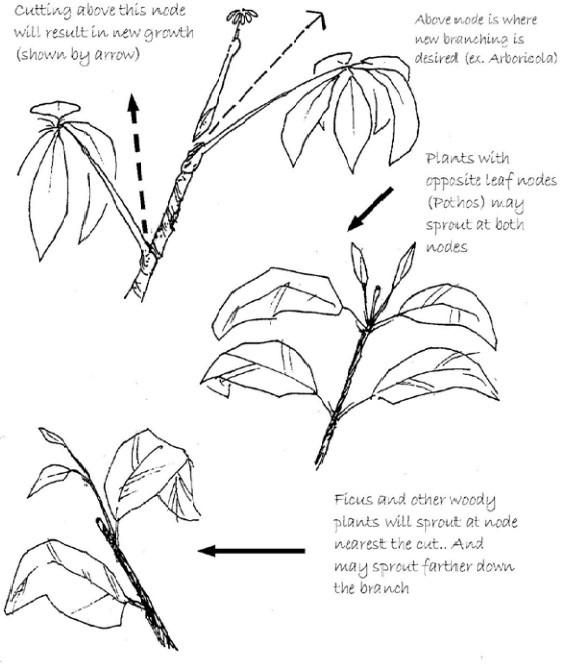
- Always prune above a node
- Always remove all stubs
- Always work with clean, insect & disease-free tools.
Trimming
| Plant | Technique |
| Aglaonema | Remove Entire stem at soil, can try to sprout roots in soil |
| Arboricola | Shape by trimming end leaves, hard prune yearly |
| Dracena | Trim brown leaf tips, notch canes to sprout |
| Ficus | Shape by trimming end leaves, hard prune yearly |
| Palms | Remove entire stem at soil, trim brown leaf tips or remove leaf |
| Spathiphyllum | Trim brown leaf tips |
| Vines | Cut at node, alternate short an long vines (=12” past pot) |
Pruning Diagram
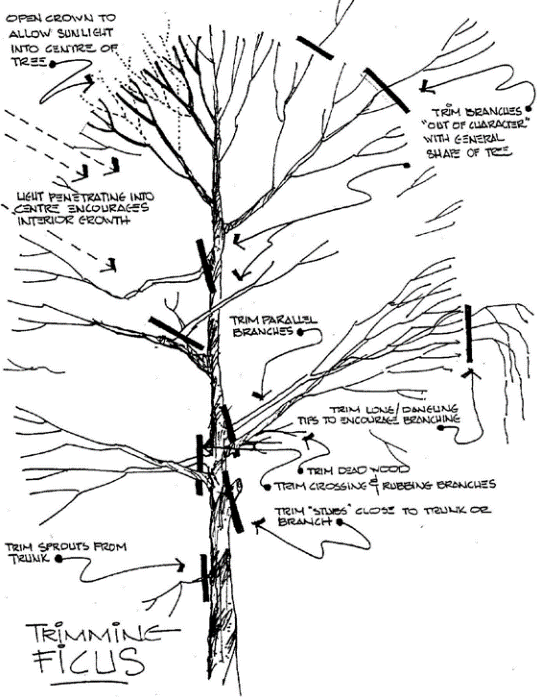
Trimming Diagram